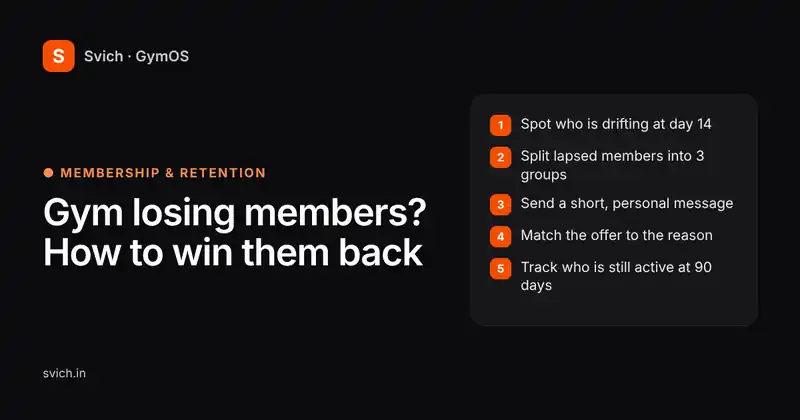
Membership & Retention
Gym Churn Rate: How to Calculate It and What’s Normal
Gym churn rate explained: the formula, a worked example, what’s normal by month and year, who cancels first, and a 20-minute monthly churn review checklist.
Want more of this in your Google results?


Short on time? Summarise it with
Gym churn rate is the share of members who leave in a period, divided by the members you had at the start of it. Monthly gym churn rate = members lost this month ÷ members at the start of the month. A monthly churn of about 3% to 4% is common for independent gyms; 3.4% a month roughly matches the industry’s 66.4% annual retention figure, about a third of members lost each year. The number only helps if you count it the same way every month, so the definitions below matter more than the formula.
Working your churn out from a spreadsheet and a payments app? Svich GymOS keeps active, lapsed and “gone quiet” members on one list, with reminders that go out before a membership ends. See how GymOS reminders work.
#How do you calculate gym churn rate?
Take the members you had on day one of the month, count how many of those people cancelled or lapsed by the last day, and divide. Leave out anyone who joined during the month; they count from next month.
At $65 a month, those 14 members were $910 of monthly revenue, or $10,920 over a year if you don’t replace them.
Write your rules down once, then never change them mid-year:
- Counts as churn: a cancellation, or a membership that lapsed and wasn’t renewed within your grace period (say 7 days).
- Doesn’t count: a freeze, a switch from monthly to annual, or moving from a membership to a PT package.
- Count people, not plans. A member with a gym plan and a PT pack is one person.
- Same day every month. Run the numbers on the 1st, for the month just ended.
The OPEX Fitness explanation of monthly churn and retention uses the same start-of-month method and makes a good point: an annual figure that mixes in new joiners drops whenever your sales drop, even if nobody is leaving faster.
#What is the average gym churn rate?
A monthly churn of about 3% to 4% is common for an independent gym (3.4% is close to the HFA figure); under 3% is good; at 5% or more, you’re replacing nearly half your members every year. Gym attrition, the same thing counted over a year, is easier to compare across the industry.
Gymdesk’s 2026 roundup cites the Health & Fitness Association’s 2025 benchmarking study at 66.4% annual member retention, meaning about a third of members leave each year (Gymdesk, 2026; HFA report release, September 2025). The same roundup says about half of new members quit within six months, though it doesn’t name a source for that figure. Be wary of benchmark pages with no source at all; many vendor articles list figures without saying where they came from.
To compare your monthly number with an annual one, compound it:
| Monthly churn | Members still with you after 12 months | Annual churn | What it means |
|---|---|---|---|
| 2% | 78.5% | 21.5% | Strong community, usually small or specialist gyms |
| 3.4% | 66.0% | 34.0% | Close to the 66.4% HFA retention figure |
| 5% | 54.0% | 46.0% | Sales are carrying the business |
| 7% | 41.9% | 58.1% | Fix onboarding before spending more on ads |
Retained after 12 months = (1 − monthly churn)12. Calculated from the monthly rates; not survey data.
Budget gyms with low prices and no contact usually sit at the high end; coached gyms and small group training at the low end. Compare yourself with your own last six months before you compare with anyone else.
#Which members are most likely to cancel?
New members in their first 90 days, and long-standing members whose visits have dropped off. Those two groups produce most cancellations, and both show warning signs weeks before the cancel email arrives.
- New members who haven’t built a habit. Someone who came 3 times in their first month and once in their second is already halfway out.
- Paying but absent. No visit in 14 days for someone who used to come twice a week.
- Payment trouble. A missed payment that nobody chases quietly becomes a lapse.
- Coach or class changes. When the 6pm coach leaves, watch the 6pm regulars.
Track churn for new members separately: of the people who joined in July, how many are still active in October? As a rule of thumb, if that number is under 70%, your problem is the first month, and no renewal offer will fix it.
#How do you reduce gym member churn before members cancel?
Contact members when their behaviour changes, not when their membership ends. A short personal message after two quiet weeks usually keeps more people than a discount at cancellation.
The 14-day nudge does the most work. Keep it short and don’t sell:
“Hi Daniel, it’s Sam from the gym. Haven’t seen you since the 3rd, all good? If evenings have got busy, the 6:30am small group has two spots and I’ll keep one for you this week.”
Three mistakes that raise churn:
- Discounting at cancellation. It trains members to threaten to leave. Offer a freeze instead; a frozen member isn’t churn and often comes back.
- Chasing payments late. After 30 days, a missed payment is a lapse in all but name.
- Same message to everyone. A member of three years and a member of three weeks need different words.
#How does Svich GymOS help you track and cut churn?
GymOS puts active members, lapsed members and leads on one list, flags paying members who’ve stopped coming, and sends the payment, renewal and win-back reminders above automatically, while the “Gone quiet” filter gives you a list to work from for the 14-day nudge. You see who’s drifting before they cancel.
- Filters for “Ending soon”, “Owe money”, “Lapsed”, “Gone quiet” and “New this month”, so the weekly call list takes a minute to build.
- An “active but absent” list of members who are still paying but have stopped visiting.
- Four reminders by WhatsApp or email: before a membership ends (default 10 days before), missed payment (default 3 days after the due date), birthday, and after a lapse (default 14 days after). Each has its own channel and send time, with a live preview of the message.
- An at-risk card showing revenue from memberships ending in the next 30 days and how much of it is already covered by a reminder.
- Follow-up tasks, so every renewal, due and lead is a task someone has to close.
- Freeze days and extensions on plans, so a freeze is recorded as a freeze, not a cancellation.
Pricing is per gym: Starter $49 a month for up to 250 active members, Growth $149 a month with unlimited members. Start free and add your members to see your “gone quiet” members today.
#What is the cost of churn for a small gym?
Each point of monthly churn on a 320-member gym is about three members a month. Cutting churn from 4.4% to 3% keeps roughly four or five extra members every month, which adds up to roughly 35 to 50 more members after a year, depending on how many you sign.
At $65 a month, 40 members is about $2,600 a month of revenue you didn’t have to sell again. Approximate, because your base changes as you go, but it shows why a churn point can be worth as much as a good ad campaign. Our guide to following up gym leads covers the sales side.
#Monthly churn review: a 20-minute checklist
Once a month, check seven numbers: start-of-month members, churn, new-member churn, cancellation reasons, quiet members, unpaid balances and renewals without a reminder.
- Members at the start of last month, and how many of them left.
- Monthly churn % next to the last six months.
- Churn for members who joined 3 months ago, on its own.
- Reasons for every cancellation, in one or two words each.
- Members with no visit in 14+ days: who’s calling them this week?
- Unpaid balances older than 7 days.
- Memberships ending in the next 30 days without a reminder set.
For the messages themselves, see our renewal message templates and freeze policy template. For the bigger picture, read our gym member retention strategies.
#Frequently asked questions
#What is the formula for gym churn rate?
Monthly gym churn rate equals the number of members who cancelled or lapsed during the month, divided by the number of members at the start of that month. Members who joined during the month are left out. Retention rate is 100% minus churn.
#What is a good churn rate for a gym?
Under 3% a month is good for an independent gym, and 3% to 4% is typical. A monthly churn of 3.4% works out to about 66% of members still active after a year, close to the 66.4% annual retention figure Gymdesk cites from the Health & Fitness Association’s 2025 benchmarking study.
#Do membership freezes count as churn?
No. A frozen member is still a member and should not be counted as churn. Count them only if they cancel or fail to return when the freeze ends. Record freezes separately so you can see how many come back.
#How do you convert monthly churn to annual churn?
Raise monthly retention to the power of 12 and subtract the result from 1. For example, 3% monthly churn gives 0.97 to the power of 12, about 0.694, so roughly 69% of members stay a full year and annual churn is about 31%.
#When are gym members most likely to cancel?
Most cancellations come from members in their first 90 days who never built a routine, and from longer-term members whose visits have dropped off. A gap of 14 days without a visit, or a missed payment that nobody chases, are common early warning signs.
#See who’s drifting before they cancel
Add your members to GymOS and open the “gone quiet” list, or show us how you track renewals today and we’ll show you how reminders would work for your gym.
Start free — no card | Book a 30-minute demo
More on GymOS: follow-up management and all GymOS features.