Membership & Retention
Gym Losing Members? How to Win Back Gym Members
How to win back gym members who have lapsed: when to contact them, message templates, which offers work, and how to tell if your win-back campaign pays off.
Want more of this in your Google results?

Short on time? Summarise it with
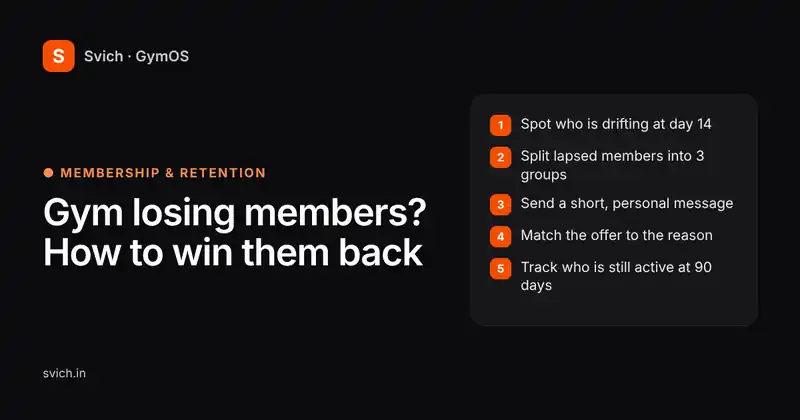
To win back gym members who have lapsed, contact them within two weeks of their last visit or membership end. Do it personally, give a reason that fits why they left, and offer an easy way back instead of a deep discount. If your gym is losing members faster than you replace them, the fix usually starts before the cancellation: most people stop coming weeks before they stop paying. Below: the timeline, the exact messages, and the two numbers that tell you if it’s paying off.
Not sure who has gone quiet? Svich GymOS lists paying members who have stopped attending and sends an automatic message after a membership lapses. See how the reminders work.
#Why is my gym losing members?
Usually because members drift away quietly, not because they decide to quit. Attendance drops first, the payment stops later, and nobody at the gym notices the gap in between.
The research backs this up. In a study of 7,752 members at three US clubs, monthly members went an average of 2.31 full months between their last visit and cancelling, and paid about $187 in that time (DellaVigna and Malmendier, American Economic Review, 2006). In a 2026 survey of 1,393 US gym members by the software company Zenoti, 53% said they had stopped attending at some point without formally cancelling, and nearly half of lapsed members said their gym never reached out (Zenoti).
So the most useful question isn’t “how do I get ex-members back?” It’s “who is drifting right now, and who notices?” For how to measure the problem, see our guide to gym churn rate.
#Who counts as a lapsed gym member?
Split them into three groups, because each one needs a different message. Treating a member who missed two weeks the same as someone who left a year ago is the most common mistake.
| Group | Who they are | What works |
|---|---|---|
| Drifting | Still paying, no visit in 14+ days | A personal check-in from a coach. No offer. |
| Recently lapsed | Membership ended or cancelled in the last 90 days | An easy restart that fits the reason they left |
| Long gone | Left 3 to 18 months ago | News: a new class, new hours, a challenge with a start date |
The drifting group is where you’ll save the most money, because they haven’t left yet. A two-line message costs nothing. Winning someone back after they’ve cancelled costs a sales conversation and often a free week.
No software yet? Export last month’s check-ins, sort by last visit, and anyone 14 or more days out who is still paying is your drifting list. And when someone cancels, ask one question, “Was it time, cost, motivation or something else?”, and write the answer down. You’ll need it for the win-back message.
#When should you contact a lapsed member?
Contact drifting members at 14 days without a visit, lapsed members within 14 days of their end date, and long-gone members no more than three or four times a year. Waiting longer only means they’ve built a new routine without you.
Stop after the member says no, or after two unanswered rounds. Only message people who have agreed to hear from you.
#What should a win-back message say?
Keep it short, from a named person, about the member rather than the gym, and finish with one easy next step. Skip the guilt (“We miss you!”) and don’t lead with a discount.
Drifting member, day 14 (WhatsApp):
“Hi Dan, it’s Chloe from the gym. Haven’t seen you since the 3rd, all good? If evenings have got busy, 6.30am is quiet and I can write you a 3 × 40-minute week. Just reply ‘yes’.”
Recently lapsed, 14 days after end (WhatsApp or email):
“Hi Aisha, your membership finished on 2 October. No pressure at all, but if it was timing or cost, tell me which and I’ll see what we can do. You can restart on your old plan from any Monday, no joining fee.”
Long gone, with news (email):
“Hi Tom, we’ve started a 6-week beginner strength block on Tuesdays and Thursdays at 7pm, capped at 10 people. It starts 4 November. Reply if you want a spot held.”
Notice what the second message does. It asks why they left in a way they can answer in one word. If they say “cost”, you can offer a cheaper plan or a freeze instead of losing them for good. Our membership freeze policy template helps with the “I’m away for a month” reply. Treat the whole thing like any gym reactivation campaign: one list, one message, one deadline.
#Should you offer a discount to win back gym members?
Usually not as the first move. A discount trains members to cancel and wait for a deal, and it doesn’t fix the reason they stopped coming.
Match the offer to the reason instead:
- “Too busy” → a shorter plan (three 40-minute sessions a week), or off-peak hours.
- “Too expensive” → a cheaper off-peak plan or a class pack, not a percentage off the full plan.
- “Lost motivation” → a booked session with a coach and a 6-week block with a start date.
- “Injured or travelling” → a freeze with a set return date.
- “Didn’t know anyone” → a small-group class. Research reported by Health Club Management found members who made a friend at the gym in the previous three months were 40% less likely to cancel (Health Club Management, 2017).
A waived joining fee is fine. It removes friction without lowering the price of the membership they’ll pay every month.
#How do you know if your win-back campaign is working?
Track two numbers: how many contacted members came back for at least one visit within 14 days, and how many are still active 90 days later. The 90-day figure is the one that matters.
If those 4 stay a year, that’s $2,640 from a few messages and calls. Use your own numbers: there’s no reliable published benchmark for gym win-back rates.
Write down who you contacted, when, what you said and what happened. After three months you’ll know which message works for your members, which beats any industry average.
#How can software help you win back gym members?
Software solves the hard part: noticing. Nobody at the front desk can remember that a member who used to come four times a week hasn’t been in for 16 days.
In Svich GymOS, the attendance area shows an “active but absent” list of paying members who have stopped coming. The member list has filters for “gone quiet”, “lapsed” and “ending soon”. Each member’s profile keeps their plan, payments, check-ins, messages and staff notes together, so the coach writing to Dan can see he trained mornings and was halfway through a programme.
GymOS also has four prebuilt automations: before a membership ends (10 days before by default), after a missed payment (3 days after), on a birthday, and after a lapse (14 days after). Each one has its own channel and send time, and you see a live preview of the message. WhatsApp messages go from your gym’s own number. A revenue-at-risk card shows how much revenue is tied to memberships ending in the next 30 days and how much of it is already covered by a reminder.
Turn on the after-lapse message, edit the wording to sound like you, and check your “active but absent” list once a week. Start free in GymOS, no card needed.
Renewals, dues and leads are tracked as tasks too, so a follow-up call doesn’t get forgotten. See follow-up management, or our renewal message templates.
#Frequently asked questions
#How do you win back gym members who cancelled?
Contact them within about two weeks of cancelling, from a named staff member, and ask in one line why they left. Then offer a restart that fits that reason, such as a cheaper off-peak plan, a freeze or a booked session with a coach, rather than a blanket discount.
#Why do gym members stop coming?
Common reasons are time, cost, lost motivation, injury and not knowing anyone. Most stop attending well before they cancel: one study of three US clubs found an average of 2.31 months between a member’s last visit and cancellation.
#What should a gym win-back message say?
It should be short, personal and about the member. Use their name and the date of their last visit or end date, ask whether timing or cost was the problem, and give one easy next step such as “reply yes” or “restart from any Monday”.
#How often should you contact former gym members?
Contact recently lapsed members once or twice in the first six weeks, then send news about three or four times a year. Stop if they say no or don’t answer two rounds in a row, and only message people who have agreed to hear from you.
#Can Svich send win-back messages automatically?
Yes. Svich GymOS has a prebuilt after-lapse automation that sends 14 days after a membership lapses. By default it uses WhatsApp from your gym’s own number, or email or text through a connected provider, and you set the send time and wording.
#Start winning back members this week
Import your member list, check who has gone quiet, and switch on the after-lapse message. Or book a call and we’ll look at your renewal and lapse numbers with you.


